



Troy University Athletics
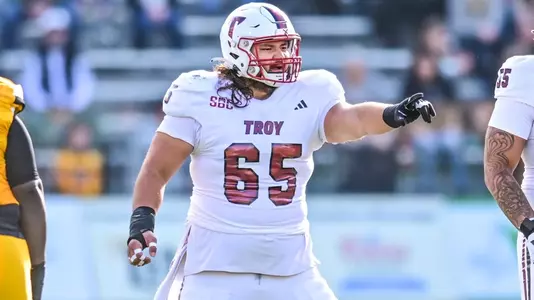
Half a World Away From Home, Tyler Cappi Found Football
5/7/2026 9:06:00 AM | Football
Tyler Cappi still remembers the first time he watched football.
He was around 12 years old, he sat in a friend's house after moving from South Korea to the U.S., watching a Raiders game with his dad. Up to that point, football was virtually unknown in his life. Raised thousands of miles from the culture of Friday night lights that shapes much of American life, he had never strapped on shoulder pads. He did not know what a counter play was. He did not know why offensive linemen pointed at linebackers before the snap.
Now, years later, Cappi has forced his way into meaningful snaps at Troy through persistence, belief and relationships forged within the program.
It has not been a straight line.
That is part of what makes his story different.
Born in Uijeongbu, South Korea, Cappi spent the first decade-plus of his life immersed in a culture that still shapes him today. His father, Tony, served in the Air Force and remained stationed in South Korea for years, where he eventually met Tyler's mother, Yangyoung, and raised their family overseas.
For Cappi, South Korea was not some temporary assignment or short-term stop. It was home.
"I was there for around 11 to 12 years," Cappi said. "That's all I knew."
He attended Korean public schools as a child and became fluent in the language. Even now, he still speaks Korean regularly with family members overseas, including his grandparents, cousins, aunts and uncles, many of whom stay up to watch Troy games from the other side of the world.
The adjustment to America was anything but easy.
Before eventually settling in Alabama, Cappi's family briefly lived in California with relatives. At the time, his parents recognized the need to begin learning English more seriously before fully transitioning to American schools. Cappi had attended a private school in South Korea to prepare for the move, but when he arrived in the United States, he quickly realized how difficult the language barrier would be.
"I was so bad at English," Cappi said. "I had private tutoring to help me speak it better."
At school, he excelled in math and science but struggled in English classes. Everything around him felt unfamiliar. Even socially, he often felt out of place as he tried to adapt to a completely different environment.
Football eventually became part of that transition.
Growing up in South Korea, Cappi mostly played pickup sports on playgrounds with classmates. Basketball, soccer and improvised backyard-style games filled his childhood. Football was never part of the equation.
"I didn't even know what football was until I came to the U.S.," he said.
Once he discovered it, though, something clicked.
He loved the physicality. He loved the structure. He loved spending time watching games with his father, a passionate Raiders fan who quickly became one of the biggest influences in his football journey.
Cappi started playing organized football shortly after moving stateside and later developed into a standout offensive lineman at Priceville (Ala.) High School. Even there, though, his football education remained limited because of the offense his high school ran.
"We never did any pass game stuff," Cappi said. "We ran the ball. Triple option, buck sweep, all that."
That lack of technical development became obvious during recruiting camps.
While many offensive linemen around the country had years of pass protection training and advanced schematic knowledge, Cappi was still learning the basics. He remembers hearing linebackers identify plays before the snap and genuinely believing opponents somehow knew his team's terminology.
"I didn't really understand football at all," Cappi admitted. "The linebacker would say, 'Counter,' and I'd think, 'How do they know our plays?'"
The COVID recruiting cycle only further complicated the process. Camps disappeared. Exposure opportunities dried up. Scholarship offers never came flooding in.
Still, Troy saw something worth betting on and offered him a walk-on opportunity.
"I would have never walked on here if I thought I had no chance," he said.
That belief became the foundation for everything that followed.
The transition into college football was overwhelming at first. Suddenly, he was surrounded by players who had years of advanced football experience. He had to learn protections, fronts, linebacker identifications and the finer details of offensive line play almost from scratch.
But he also found coaches willing to invest in him.
Cappi consistently points to offensive line coach Cole Popovich and graduate assistant Alex Ward as major influences on his early development. They helped bridge the gap between raw physical ability and football understanding.
More importantly, the coaching staff built trust with him long before he ever became a contributor.
That trust mattered during the hardest moments of his career.
Cappi suffered an ankle injury during spring practice last season and reached a point where he seriously considered quitting football altogether. The recovery process frustrated him. He felt buried on the depth chart again. Confidence disappeared.
"There was a moment where I was like, man, I don't think I can do it," he said.
He even planned out how he would walk into head coach Gerad Parker's office and tell him he was done.
Then one practice changed everything.
Cappi turned in one of the best practices of his career that day, even while still fighting through physical limitations. Later that night, defensive coordinator Dontae Wright contacted him and asked to talk.
The conversation stayed with Cappi.
Wright, who was Cappi's leadership development coach, noticed something was off and reached out personally. Offensive line coach Caleb Carbine did the same. Instead of allowing Cappi to spiral deeper into doubt, they reminded him why he belonged.
"He put some hope in my heart," Cappi said of Wright.
That moment reinforced something Cappi already believed about the Troy staff. The relationships extend far beyond football.
"It's big," he said. "You get to build connections with coaches you normally wouldn't even talk to."
Those connections helped sustain him through the uncertainty that often comes with being a walk-on player fighting for opportunities.
When his opportunities finally arrived, he delivered.
In 2024, Cappi saw meaningful snaps at Memphis after injuries forced Troy to shuffle the offensive line. The following week, he started on the road at Iowa, one of college football's toughest environments.
For a former walk-on who once struggled to understand football terminology, the moment felt surreal.
"Coach Carbine came up to me and said, 'You're about to play your first snap ever in college football,'" Cappi recalled. "I was like, 'Oh my gosh, this is insane.'"
Veteran teammates helped calm his nerves. Offensive lineman Eli Russ provided encouragement before the Iowa game and helped him process defensive looks throughout the week.
That support system became another reminder of how far Cappi had come.
His relationship with Carbine also holds special meaning because their journeys mirror each other in many ways. Carbine, a former walk-on turned starter at Troy, once navigated the challenges of earning respect through persistence and development.
"He always told me my time was coming," Cappi said. "He said once you become a scholarship player, nothing changes. You still do the same process, same work, same effort."
That mentality resonates deeply with Cappi because his path has never centered around shortcuts or entitlement.
Everything has required work.
Even now, despite carving out a role, he continues to approach football with the same mentality he had as a walk-on trying to survive his first practices.
His family remains at the center of that motivation.
Cappi lights up talking about his father, who rarely misses a chance to support him publicly or privately. Whether helping financially during the walk-on years, offering encouragement during difficult stretches or proudly sharing his son's accomplishments online, his dad has remained a constant source of stability.
"He's always been on my side," Cappi said. "He always knew I could do it."
His older brother Jacob has helped too, often pitching in financially to ease some of the burden that comes with college life as a former walk-on player.
"They've always been supportive," Cappi said. "They're great."
Off the field, Cappi still holds tightly to the culture he grew up in. He meal preps Korean food regularly, cooking dishes like bulgogi, kimchi and traditional soups for himself and occasionally teammates. After his football career ends, he hopes to travel back to South Korea with his family and reconnect with relatives he has not seen in years.
That balance between cultures remains central to who he is.
Part South Korean kid who once wandered playgrounds overseas with no clue what football was.
Part Alabama football player who fought through doubt, injuries and obscurity to earn his place inside a Division I program.
Cappi's journey has never followed the traditional blueprint.
That is exactly what makes it memorable.
He was around 12 years old, he sat in a friend's house after moving from South Korea to the U.S., watching a Raiders game with his dad. Up to that point, football was virtually unknown in his life. Raised thousands of miles from the culture of Friday night lights that shapes much of American life, he had never strapped on shoulder pads. He did not know what a counter play was. He did not know why offensive linemen pointed at linebackers before the snap.
Now, years later, Cappi has forced his way into meaningful snaps at Troy through persistence, belief and relationships forged within the program.
It has not been a straight line.
That is part of what makes his story different.
Born in Uijeongbu, South Korea, Cappi spent the first decade-plus of his life immersed in a culture that still shapes him today. His father, Tony, served in the Air Force and remained stationed in South Korea for years, where he eventually met Tyler's mother, Yangyoung, and raised their family overseas.
For Cappi, South Korea was not some temporary assignment or short-term stop. It was home.
"I was there for around 11 to 12 years," Cappi said. "That's all I knew."
He attended Korean public schools as a child and became fluent in the language. Even now, he still speaks Korean regularly with family members overseas, including his grandparents, cousins, aunts and uncles, many of whom stay up to watch Troy games from the other side of the world.
The adjustment to America was anything but easy.
Before eventually settling in Alabama, Cappi's family briefly lived in California with relatives. At the time, his parents recognized the need to begin learning English more seriously before fully transitioning to American schools. Cappi had attended a private school in South Korea to prepare for the move, but when he arrived in the United States, he quickly realized how difficult the language barrier would be.
"I was so bad at English," Cappi said. "I had private tutoring to help me speak it better."
At school, he excelled in math and science but struggled in English classes. Everything around him felt unfamiliar. Even socially, he often felt out of place as he tried to adapt to a completely different environment.
Football eventually became part of that transition.
Growing up in South Korea, Cappi mostly played pickup sports on playgrounds with classmates. Basketball, soccer and improvised backyard-style games filled his childhood. Football was never part of the equation.
"I didn't even know what football was until I came to the U.S.," he said.
Once he discovered it, though, something clicked.
He loved the physicality. He loved the structure. He loved spending time watching games with his father, a passionate Raiders fan who quickly became one of the biggest influences in his football journey.
Cappi started playing organized football shortly after moving stateside and later developed into a standout offensive lineman at Priceville (Ala.) High School. Even there, though, his football education remained limited because of the offense his high school ran.
"We never did any pass game stuff," Cappi said. "We ran the ball. Triple option, buck sweep, all that."
That lack of technical development became obvious during recruiting camps.
While many offensive linemen around the country had years of pass protection training and advanced schematic knowledge, Cappi was still learning the basics. He remembers hearing linebackers identify plays before the snap and genuinely believing opponents somehow knew his team's terminology.
"I didn't really understand football at all," Cappi admitted. "The linebacker would say, 'Counter,' and I'd think, 'How do they know our plays?'"
The COVID recruiting cycle only further complicated the process. Camps disappeared. Exposure opportunities dried up. Scholarship offers never came flooding in.
Still, Troy saw something worth betting on and offered him a walk-on opportunity.
"I would have never walked on here if I thought I had no chance," he said.
That belief became the foundation for everything that followed.
The transition into college football was overwhelming at first. Suddenly, he was surrounded by players who had years of advanced football experience. He had to learn protections, fronts, linebacker identifications and the finer details of offensive line play almost from scratch.
But he also found coaches willing to invest in him.
Cappi consistently points to offensive line coach Cole Popovich and graduate assistant Alex Ward as major influences on his early development. They helped bridge the gap between raw physical ability and football understanding.
More importantly, the coaching staff built trust with him long before he ever became a contributor.
That trust mattered during the hardest moments of his career.
Cappi suffered an ankle injury during spring practice last season and reached a point where he seriously considered quitting football altogether. The recovery process frustrated him. He felt buried on the depth chart again. Confidence disappeared.
"There was a moment where I was like, man, I don't think I can do it," he said.
He even planned out how he would walk into head coach Gerad Parker's office and tell him he was done.
Then one practice changed everything.
Cappi turned in one of the best practices of his career that day, even while still fighting through physical limitations. Later that night, defensive coordinator Dontae Wright contacted him and asked to talk.
The conversation stayed with Cappi.
Wright, who was Cappi's leadership development coach, noticed something was off and reached out personally. Offensive line coach Caleb Carbine did the same. Instead of allowing Cappi to spiral deeper into doubt, they reminded him why he belonged.
"He put some hope in my heart," Cappi said of Wright.
That moment reinforced something Cappi already believed about the Troy staff. The relationships extend far beyond football.
"It's big," he said. "You get to build connections with coaches you normally wouldn't even talk to."
Those connections helped sustain him through the uncertainty that often comes with being a walk-on player fighting for opportunities.
When his opportunities finally arrived, he delivered.
In 2024, Cappi saw meaningful snaps at Memphis after injuries forced Troy to shuffle the offensive line. The following week, he started on the road at Iowa, one of college football's toughest environments.
For a former walk-on who once struggled to understand football terminology, the moment felt surreal.
"Coach Carbine came up to me and said, 'You're about to play your first snap ever in college football,'" Cappi recalled. "I was like, 'Oh my gosh, this is insane.'"
Veteran teammates helped calm his nerves. Offensive lineman Eli Russ provided encouragement before the Iowa game and helped him process defensive looks throughout the week.
That support system became another reminder of how far Cappi had come.
His relationship with Carbine also holds special meaning because their journeys mirror each other in many ways. Carbine, a former walk-on turned starter at Troy, once navigated the challenges of earning respect through persistence and development.
"He always told me my time was coming," Cappi said. "He said once you become a scholarship player, nothing changes. You still do the same process, same work, same effort."
That mentality resonates deeply with Cappi because his path has never centered around shortcuts or entitlement.
Everything has required work.
Even now, despite carving out a role, he continues to approach football with the same mentality he had as a walk-on trying to survive his first practices.
His family remains at the center of that motivation.
Cappi lights up talking about his father, who rarely misses a chance to support him publicly or privately. Whether helping financially during the walk-on years, offering encouragement during difficult stretches or proudly sharing his son's accomplishments online, his dad has remained a constant source of stability.
"He's always been on my side," Cappi said. "He always knew I could do it."
His older brother Jacob has helped too, often pitching in financially to ease some of the burden that comes with college life as a former walk-on player.
"They've always been supportive," Cappi said. "They're great."
Off the field, Cappi still holds tightly to the culture he grew up in. He meal preps Korean food regularly, cooking dishes like bulgogi, kimchi and traditional soups for himself and occasionally teammates. After his football career ends, he hopes to travel back to South Korea with his family and reconnect with relatives he has not seen in years.
That balance between cultures remains central to who he is.
Part South Korean kid who once wandered playgrounds overseas with no clue what football was.
Part Alabama football player who fought through doubt, injuries and obscurity to earn his place inside a Division I program.
Cappi's journey has never followed the traditional blueprint.
That is exactly what makes it memorable.
Players Mentioned

OL
/ Football
OL
/ FootballThursday, September 24
Wednesday, September 23
Monday, September 21
Monday, September 21