










Troy University Athletics
11/4/2026 3:12:00 PM | Tennis (M), Tennis (W)
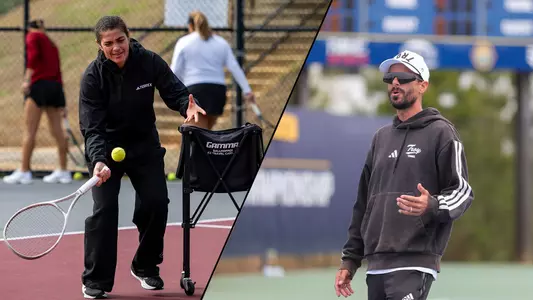
Longtime Troy University tennis coaches Rawia Elsisi and Rolando Vargas are thankful for the opportunities they were afforded as student-athletes and now strive to provide the same positive experience to their players.
"What I enjoy the most is giving the student-athlete the whole experience - watching them grow and getting better on and off the court," Elsisi said. "I want to give them as good of an experience as I had."
Elsisi was a star player for the Trojans (2006-2009) and is in her 14th season as head women's tennis coach.
Vargas was a standout player at Troy (2001-2003) and is in his ninth year as the head men's tennis coach.
"Really it's about the players graduating and being ambassadors," Vargas said. "I really want players that can commit and graduate from Troy, and still bleed Troy."
Both had interesting journeys to Alabama. Elsisi is a native of Egypt who followed her older sister to Troy. Vargas is a native of Mexico who transferred to the university thanks in large part to a former college teammate at Bethune-Cookman.
Not only did they find Troy to be a place to hone their tennis skills and earn college degrees, but it would ultimately become home.
"I've been here longer than any of the other coaches," Elsisi said. "It's a good town with good people. If you get the right player, they stay the whole time here and graduate."
Vargas had two other head coaching jobs on the college tennis level before returning to Troy.
"Obviously I grew up in Mexico for 18 very important years of my life, but now I've been in the United States more than I've been in Mexico," Vargas said.
"Most of my years have been here in Troy. There was no better goal for me than to come back to Troy and try to win in Troy, because it was my alma mater and gave me so much."
From Egypt to Troy
Elsisi was the top-ranked junior player in Egypt before coming to the United States with her older sister of 15 months, Shaimaa, to train for the sport in California.
"We were trying to play professionally just a little bit," Elsisi said. "My sister had already had one year of college in Egypt."
While training in California, Elsisi suffered an ACL knee injury which required surgery.
At the time, the two were being recruited by the coach at the University of South Alabama.
"A lot of Egyptian guys used to go to South Alabama," Elsisi said of the initial connection. "South Alabama was the first one to reach out to us. The coach at South Alabama found out I tore my ACL and he was a little questioning about me recovering from ACL surgery."
Troy coach Eric Hayes, who led both the men's and women's programs, then came into the picture.
"Coach Hayes reached out to my sister and she liked him and said we were coming," Elsisi remembers. "I was working on my knee, and my sister said, 'I'm signing you up for the ACT … you're taking the exam.' My parents were OK with us going to the same place together.
"On Jan. 5, 2005, I arrived at Troy. If it wasn't for my sister, I wouldn't be in Troy."
Elsisi finds success
Elsisi spent the first year at Troy rehabilitating from her knee injury and took a redshirt year while her older sister played for the Trojans.
When Elsisi returned to the court the following season, her sister only had one year of eligibility left and would graduate and move on to Tampa to coach at a community college the next year.
Elsisi would play at the No. 1 singles spot for Troy most of her four years of eligibility, all winning seasons for the Trojans.
Despite the success as a player, Elsisi wasn't particularly interested in playing professionally.
"I enjoyed all the four years I had played, but I didn't know how my body would handle another injury, especially on the knee," Elsisi said. "It's a tough injury to come back from, the ACL.
"I would have loved to continue playing tennis, but decided I was going to focus on getting my post graduate degrees."
Elsisi was an exceptional student at Troy, earning her bachelor's degree in sports and fitness management with a minor in business administration in 2008. She was a four-time Sun Belt Conference Commissioner's List honoree and won the Sorrell Award, given every year to Troy's graduating female student-athlete with the highest GPA.
In 2010, Elsisi earned her master's degree in sport and fitness management with a concentration in sports administration. She began serving as an adjunct professor at Troy, teaching a tennis class which she continues to currently do on campus.
"I kind of fell in love with college and teaching in college, but I wanted to coach for a little bit," Elsisi said.
Elsisi was a volunteer instructor at several tennis clubs before Hayes had an opening on his tennis staff in 2011 and hired Elsisi.
"When the position opened, I said, 'I'm going to take it,'" Elsisi said. "I became an assistant coach for almost two seasons."
Longevity as a coach
She didn't ever plan on being a head coach, but when Hayes left to take the head coaching job at Mercer University in August of 2013, he handed the reins over to Elsisi to lead the women's program.
"He's like, 'Here you go,'" Elsisi remembers. "I honestly had a plan that I wanted to do four to five years of coaching in college, but I wasn't planning on being a head coach - I was going to be an assistant.
"There was recruiting and handling the budget. There's a lot that I didn't want to jump into right away after just a year-and-a-half."
Yet Elsisi was hired to lead the Trojans and embraced it. She's never looked back and has compiled a career coaching record of 141-120 overall and 51-42 in Sun Belt play.
Elsisi believes her longevity at Troy is a plus for recruiting, especially players with international backgrounds. This year's roster is made up of three players from Egypt, two from Tunisia, one from Mexico and one from Germany.
"I'm not switching from job to job," Elsisi said of the stability. "They see the commitment. It's a big international sport. If you look at any roster in the country, you'll find a high percentage of international students.
"The girls watch social media and they want to look at the cities, like, 'We want to be in Florida; we want to be California.' They just think big, big. So these are challenges, but also being here I have some players from Egypt because I'm here.
"They (parents) feel comfortable that they leave their daughters with me. I had one dad say, 'You just make them feel at home. You take the ease of being homesick the first semester.'
"That reflects back to I've been in their shoes before and I want to give them the best experience they can get. That's kind of what I have a passion for."
Elsisi wants to help her players attain their goals, whether it's in tennis or in the working world.
"I understand some players are pretty good and they want to go play as a professional, and for some the goal is just wanting to get a degree and go into coaching or work in another business," Elsisi said. "I want to support them 100 percent of what their goals are.
"I like the challenge of having someone to work with to develop them into a better tennis player, and also help them off court with academics and life."
Vargas trades places
Vargas came to the United States from Mexico in 2000 on a college tennis scholarship to Bethune-Cookman University in Daytona Beach, Fla., but after two years was set to transfer to Southeastern Louisiana.
"For whatever reason, the coach who offered me the national letter-of- intent ended up taking another job at the last minute in West Virginia," Vargas said. "One week before the fall semester, I didn't have anywhere to go. I didn't know what to do."
His roommate at Bethune-Cookman, Pablo Martinez, had already committed to transfer and play for Chad Hebert at Troy.
"I searched online for the Troy University team and I saw there were some seniors," Vargas said. "So I was like, 'Maybe I can get an opportunity if they are still looking.'
"I wrote to the coach and he got in touch with Pablo, and Pablo said good things about me. We ended up transferring together to Troy."
Vargas played No. 1 singles and doubles during his playing career at Troy and was an Academic All-Conference selection as a senior in 2003.
Still needing to complete some course work to graduate due to some course credits from Bethune-Cookman not transferring when he came to Troy, Vargas became a student assistant coach for the Trojans in 2004 while completing his school work.
"It wasn't my intention to be a coach at the time," Vargas said. "I was just helping the team and finishing school. I was preparing myself to play professionally."
From player to coach
Vargas became a pro tennis player after earning his degree in international business and his master's degree in sports management.
"My girlfriend came with me to Mexico (while playing pro), which was a risky move on her end by coming to another country where she didn't speak the language," Vargas said. "I was really grateful to have her in my life. My goals were to play professionally and my girlfriend followed me.
"I played professionally for three years and then we married and our daughter came. When that happened, I realized I had to make some decisions based on my daughter. Obviously that changed my life."
Vargas was offered the chance to return to Troy as a graduate assistant coach for Hayes, who continued to oversee both the men's and women's programs.
"I knew this was going to be a good opportunity to go back to the United States and give my daughter a better life," Vargas said. "That's how I came back and became Coach Hayes' assistant. I did like coaching the players, but I didn't know the direction it was going to take me."
Vargas worked as a graduate assistant from 2007 to 2009.
"I felt like the players enjoyed my advice and I enjoyed working with them," Vargas said. "They were ones that really were pushing me to stay in the tennis world.
"Coach Hayes was a big influence in giving me a lot of duties from the beginning. If it wasn't for him, I don't think I would have been prepared to be a coach.
"People think being a coach is just playing tennis, but Coach Hayes gave me a very good background of what you have to do in the office."
After his time as a graduate assistant at Troy, Vargas became a tennis instructor at a country club in Montgomery. In 2010, Vargas would land the job as head men's and women's tennis coach at Auburn University at Montgomery (AUM).
Over the next seven seasons, Vargas would lead AUM to great success. The women's team won four NAIA national championships (2011, 2012, 2013, 2015) and the men's team finished runner-up for a national title in 2013.
Wanting a new challenge, Vargas then took the job as head men's tennis coach at Division I Radford (Va.) University in 2017.
"It was very difficult to leave because it (AUM) was one of the best programs … not only in the NAIA Div. II … but probably in the United States," Vargas said.
"Then I took the job of the worst team in the Big South Conference, so it was a big learning experience. I was there a year and was learning to be on the other side of the coin."
Returning to Troy
Radford had a 10-12 record the year Vargas took over and he was then offered a chance to come back to Troy as men's tennis coach to replace Scott Kidd, who left for Arkansas State.
"When I first came I had a team in the bottom of the conference," Vargas said. "We were seven out of eight, and then Appalachian State cut their men's tennis program, so we were basically seventh out of seven."
Vargas has steadily built Troy into a strong program. Under his tutelage, the Trojans have a 145-53 overall mark and 20-22 record in the Sun Belt.
"I couldn't have done it without the players believing in what we were wanting to do," Vargas said of his early Troy teams. "I still talk to them to this day. I think that's been the reason we've been so successful these eight years.
"We're one of the teams that have been so consistent for these eight years - having 16 to 17 to 18 wins consistently, two 20-win seasons and last year we had 24 wins. That's not easy to do to be that consistent."
Vargas praises his current and former players for buying into the program.
"The players have been taking charge of what it means to be a Trojan and have come and fought for each other, but more importantly for the people before them," Vargas said.
"I tell the guys that the history of tennis in Troy goes before the 2000s. It's been very, very good not only in the eight years I've been here, but before that. When I was here putting in my little grain of sand (as a player), Pablo was ranked the whole year his senior year.
"When I took the job, I wanted to keep that tradition. That's why I want to stay here. I want nothing more than to keep winning and going in the right direction.
"I'm really grateful to be the leader and be the head coach, and grateful for the support I've gotten from the administrators. It makes you want to do even better."