









Troy University Athletics
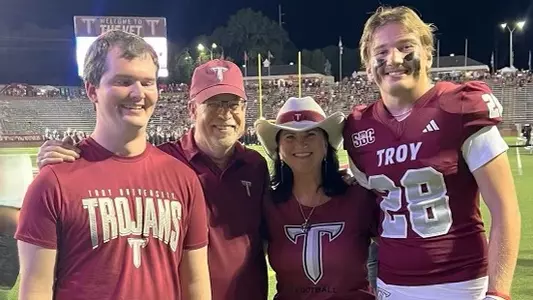
The Brother Who Taught Him to See Differently; Evan Crenshaw's Family Leads the Way
8/11/2026 12:19:00 PM | Football
For all the hours spent on the practice field, the pressure of game day and the recognition that followed a breakthrough season, Evan Crenshaw's biggest source of motivation has little to do with football.
It starts at home.
It starts with Taylor.
Nine years older and born blind, his half-brother has spent his life navigating circumstances he never chose. He lives independently, goes to the gym, plays the drums and makes his way through the world on his own terms.
And his younger brother has watched all of it.
He has watched Taylor find independence where others might expect dependence. He has watched him embrace life without letting circumstances beyond his control dictate what he can do. Along the way, those lessons have shaped the way he views his own opportunities.
"He's basically like my why," Crenshaw said.
Taylor is one part of that why. Their mother, Rose, and Evan's father, Robert, are the others.
Together, they form the foundation behind a football career that has taken their son from a baseball-heavy childhood to a position he never initially planned to play, and eventually to national recognition as one of the country's top punters.
The awards and attention that came with last season were new.
The motivation was not.
His perspective was shaped long before he became an All-American.
Taylor grew up alongside him in Greenville, South Carolina, after the family moved there from Florida when he was four years old. The two brothers were never in school at the same time because of their nine-year age difference, but Taylor was always present.
He was there as his younger brother grew up.
And now, he is there on Saturdays.
Taylor attends every home football game, sitting beside their mother and taking in the atmosphere. He cannot see what is happening on the field, so Rose provides a running commentary, giving him the information he needs to follow the game.
"He gets every kind of information he needs," his brother said.
Taylor has also learned football from years of listening, talking and asking questions. On the road, he can follow along through the broadcast. At home, he sits next to Rose and absorbs the game through her descriptions and everything his brother has told him over the years.
For Taylor, being at the games is about more than keeping up with a scoreboard.
He loves the crowd. He loves the atmosphere. He loves being part of it.
That makes the family ritual after games even more meaningful.
After every home game, the family goes to dinner together. They talk about what happened, how the team played and how the game felt. The next morning, they go to breakfast.
Those quieter moments give the brothers time together.
They do not spend breakfast breaking down every punt or analyzing every snap. They talk about how the game felt, what happened and everything surrounding it. Taylor also likes hearing about the parts of college football that spectators never see: the locker room, the fans, the media attention and the stories that come with being a college athlete.
Taylor is interested in plenty of things beyond football, too. He plays drums. He loves music. He is fascinated by military aircraft. He follows politics closely. And, according to his brother, once Taylor finds a subject he enjoys, he can talk about it for as long as anyone will listen.
That relationship has given the younger brother something that can be difficult to maintain in college athletics: perspective.
He knows he has been given abilities that are outside his control. He also knows his brother has faced circumstances outside of his control.
Watching Taylor respond to his circumstances has made him more grateful for his own.
That same lesson has come from his father.
Robert has battled lymphoma twice. His most recent fight came only a few months ago, and he is now in remission. Through both battles, his son has watched his father approach difficult circumstances with the same philosophy that has shaped the rest of the family: make the best of what life gives you.
Then there is Rose.
She has been the constant.
She has been at every visit and every camp. She has followed her son's athletic career wherever it has taken him. She has never missed a game in any sport. If there is a home game, she is there. If the family can make the trip, she is there.
"She's just been kind of the workhorse of the family," he said.
It is a description that explains more than the logistics of getting everyone to football games.
The family's story has involved moves, medical decisions, athletic sacrifices and the daily work of supporting one another.
The family originally lived in the Orlando area, where he was born in Winter Park in 2004. After a series of hurricanes and two break-ins at their home, they moved to Greenville when he was four.
Greenville became home.
He still considers it the place where he grew up, and he hopes to return there after college and eventually settle down. He remembers the people, the community and the years spent there fondly.
The family eventually moved back to Jacksonville when he was entering eighth grade. The primary reason was his father's medical care. The Mayo Clinic in Jacksonville offered better options for Robert's treatment than those available around South Carolina.
It was a difficult transition for a young athlete who had already changed schools several times.
But it was another chapter in a life where circumstances rarely stayed still for long.
Football, meanwhile, was not always supposed to be the main attraction.
Baseball was his first sport.
He played it for as long as he could remember and continued through his junior year of high school. Soccer lasted much less time. He tried it when he was around four and quickly decided he did not like getting kicked in the shins.
Football eventually became the sport that stuck.
Even then, punter was not where he started.
As a freshman, he played strong safety. The following year, his high school's starting kicker and punter graduated, leaving an opening. He had occasionally experimented with kicking after practice, and one of his coaches, Coach Canterbury, noticed.
That moment changed the trajectory of his athletic career.
Canterbury connected him with a local trainer in Jacksonville. From there, the work accelerated. Summers became filled with training. The position became a serious pursuit. Eventually, football took over as baseball faded into the background.
The transition required an unusual level of attention to detail.
At the college level, punting can look simple from the stands. A player catches the snap, takes a few steps and kicks the ball.
The reality is much more precise.
According to him, the margin between a good punt and a bad one can be measured in inches. The drop has to be right. The contact point has to be right. The steps have to be right. The direction has to be right.
He estimates there is roughly a five- to six-inch window for the ideal contact.
Miss that window, and the result can change quickly.
That is why he spends so much time working on things spectators rarely notice, including his hands. He has spent countless hours on drills designed to improve his ability to catch and control the ball.
Good hands and a good drop form the foundation.
Everything else builds from there.
That precision became increasingly visible last season.
He knew he was capable of having a strong year. He did not know whether everything would align for the national recognition that eventually followed.
It did.
He earned first team All-America honors and found himself dealing with a level of attention that was unfamiliar. Awards came in. People reached out. Other punters' performances became part of the conversation.
For him, the hardest part was not necessarily performing.
It was maintaining focus while everything around the performance grew louder.
"There's some things that just have to go your way," he said.
The season became a test of more than his leg.
It became a test of his ability to stay mentally locked in.
One of the defining moments came against Buffalo.
Late in the game, with the outcome still in doubt, the coaching staff sent the punt team onto the field. He delivered, pinning Buffalo deep near its own goal line.
The defense forced a three-and-out. The offense eventually scored. Troy won.
For the punter, the play carried significance beyond the statistics.
It was evidence that the trust between him and the coaching staff was real. It was confidence made visible in a moment that mattered.
And for the team, it became part of a larger stretch defined by a refusal to quit.
The lesson carried forward.
The following conference championship game against James Madison provided a different lesson. Things did not go according to plan, and he walked away believing he could have performed better.
But the experience reinforced something he now teaches younger kickers.
Things are going to go wrong.
The important part is what happens next.
"You don't want your mind to be clouded over the last thing and have it compound and build," he said.
That mentality is becoming part of the way he approaches his own career.
The football journey, he hopes, has a long way to go. He jokes about still punting at 60, but eventually there will be a life after football.
He is majoring in economics and sees himself somewhere in the financial world, potentially as an analyst or adviser.
The common thread is people.
He likes numbers, but he does not picture himself sitting alone at a desk all day. He wants to talk with people, build relationships and work in a field where he can combine those skills.
For now, though, the focus remains on football.
And behind that focus is the family that has been there from the beginning.
Taylor will continue to be in the stands, listening to Rose explain what is happening on the field.
Robert will be there when he can, continuing his recovery and showing his son what resilience looks like.
Rose will be there because, by now, that is what she does.
She has never missed a game.
And after the final whistle, the family will gather around a dinner table and talk about what happened.
For everyone else, the game may be measured in yards, scores, wins, losses and statistics.
For him, football carries something more personal.
Every punt is part of a career he has worked hard to build.
Every Saturday is another opportunity to do something with abilities he knows he did not create for himself.
And every time he looks toward the stands, he is reminded of the people who taught him how to respond to circumstances he cannot control.
That is why Taylor matters.
That is why Rose matters.
That is why Robert matters.
They are the reason behind the work.
The reason he keeps pushing.
The reason the journey means more than what happens on the scoreboard.
It starts at home.
It starts with Taylor.
Nine years older and born blind, his half-brother has spent his life navigating circumstances he never chose. He lives independently, goes to the gym, plays the drums and makes his way through the world on his own terms.
And his younger brother has watched all of it.
He has watched Taylor find independence where others might expect dependence. He has watched him embrace life without letting circumstances beyond his control dictate what he can do. Along the way, those lessons have shaped the way he views his own opportunities.
"He's basically like my why," Crenshaw said.
Taylor is one part of that why. Their mother, Rose, and Evan's father, Robert, are the others.
Together, they form the foundation behind a football career that has taken their son from a baseball-heavy childhood to a position he never initially planned to play, and eventually to national recognition as one of the country's top punters.
The awards and attention that came with last season were new.
The motivation was not.
His perspective was shaped long before he became an All-American.
Taylor grew up alongside him in Greenville, South Carolina, after the family moved there from Florida when he was four years old. The two brothers were never in school at the same time because of their nine-year age difference, but Taylor was always present.
He was there as his younger brother grew up.
And now, he is there on Saturdays.
Taylor attends every home football game, sitting beside their mother and taking in the atmosphere. He cannot see what is happening on the field, so Rose provides a running commentary, giving him the information he needs to follow the game.
"He gets every kind of information he needs," his brother said.
Taylor has also learned football from years of listening, talking and asking questions. On the road, he can follow along through the broadcast. At home, he sits next to Rose and absorbs the game through her descriptions and everything his brother has told him over the years.
For Taylor, being at the games is about more than keeping up with a scoreboard.
He loves the crowd. He loves the atmosphere. He loves being part of it.
That makes the family ritual after games even more meaningful.
After every home game, the family goes to dinner together. They talk about what happened, how the team played and how the game felt. The next morning, they go to breakfast.
Those quieter moments give the brothers time together.
They do not spend breakfast breaking down every punt or analyzing every snap. They talk about how the game felt, what happened and everything surrounding it. Taylor also likes hearing about the parts of college football that spectators never see: the locker room, the fans, the media attention and the stories that come with being a college athlete.
Taylor is interested in plenty of things beyond football, too. He plays drums. He loves music. He is fascinated by military aircraft. He follows politics closely. And, according to his brother, once Taylor finds a subject he enjoys, he can talk about it for as long as anyone will listen.
That relationship has given the younger brother something that can be difficult to maintain in college athletics: perspective.
He knows he has been given abilities that are outside his control. He also knows his brother has faced circumstances outside of his control.
Watching Taylor respond to his circumstances has made him more grateful for his own.
That same lesson has come from his father.
Robert has battled lymphoma twice. His most recent fight came only a few months ago, and he is now in remission. Through both battles, his son has watched his father approach difficult circumstances with the same philosophy that has shaped the rest of the family: make the best of what life gives you.
Then there is Rose.
She has been the constant.
She has been at every visit and every camp. She has followed her son's athletic career wherever it has taken him. She has never missed a game in any sport. If there is a home game, she is there. If the family can make the trip, she is there.
"She's just been kind of the workhorse of the family," he said.
It is a description that explains more than the logistics of getting everyone to football games.
The family's story has involved moves, medical decisions, athletic sacrifices and the daily work of supporting one another.
The family originally lived in the Orlando area, where he was born in Winter Park in 2004. After a series of hurricanes and two break-ins at their home, they moved to Greenville when he was four.
Greenville became home.
He still considers it the place where he grew up, and he hopes to return there after college and eventually settle down. He remembers the people, the community and the years spent there fondly.
The family eventually moved back to Jacksonville when he was entering eighth grade. The primary reason was his father's medical care. The Mayo Clinic in Jacksonville offered better options for Robert's treatment than those available around South Carolina.
It was a difficult transition for a young athlete who had already changed schools several times.
But it was another chapter in a life where circumstances rarely stayed still for long.
Football, meanwhile, was not always supposed to be the main attraction.
Baseball was his first sport.
He played it for as long as he could remember and continued through his junior year of high school. Soccer lasted much less time. He tried it when he was around four and quickly decided he did not like getting kicked in the shins.
Football eventually became the sport that stuck.
Even then, punter was not where he started.
As a freshman, he played strong safety. The following year, his high school's starting kicker and punter graduated, leaving an opening. He had occasionally experimented with kicking after practice, and one of his coaches, Coach Canterbury, noticed.
That moment changed the trajectory of his athletic career.
Canterbury connected him with a local trainer in Jacksonville. From there, the work accelerated. Summers became filled with training. The position became a serious pursuit. Eventually, football took over as baseball faded into the background.
The transition required an unusual level of attention to detail.
At the college level, punting can look simple from the stands. A player catches the snap, takes a few steps and kicks the ball.
The reality is much more precise.
According to him, the margin between a good punt and a bad one can be measured in inches. The drop has to be right. The contact point has to be right. The steps have to be right. The direction has to be right.
He estimates there is roughly a five- to six-inch window for the ideal contact.
Miss that window, and the result can change quickly.
That is why he spends so much time working on things spectators rarely notice, including his hands. He has spent countless hours on drills designed to improve his ability to catch and control the ball.
Good hands and a good drop form the foundation.
Everything else builds from there.
That precision became increasingly visible last season.
He knew he was capable of having a strong year. He did not know whether everything would align for the national recognition that eventually followed.
It did.
He earned first team All-America honors and found himself dealing with a level of attention that was unfamiliar. Awards came in. People reached out. Other punters' performances became part of the conversation.
For him, the hardest part was not necessarily performing.
It was maintaining focus while everything around the performance grew louder.
"There's some things that just have to go your way," he said.
The season became a test of more than his leg.
It became a test of his ability to stay mentally locked in.
One of the defining moments came against Buffalo.
Late in the game, with the outcome still in doubt, the coaching staff sent the punt team onto the field. He delivered, pinning Buffalo deep near its own goal line.
The defense forced a three-and-out. The offense eventually scored. Troy won.
For the punter, the play carried significance beyond the statistics.
It was evidence that the trust between him and the coaching staff was real. It was confidence made visible in a moment that mattered.
And for the team, it became part of a larger stretch defined by a refusal to quit.
The lesson carried forward.
The following conference championship game against James Madison provided a different lesson. Things did not go according to plan, and he walked away believing he could have performed better.
But the experience reinforced something he now teaches younger kickers.
Things are going to go wrong.
The important part is what happens next.
"You don't want your mind to be clouded over the last thing and have it compound and build," he said.
That mentality is becoming part of the way he approaches his own career.
The football journey, he hopes, has a long way to go. He jokes about still punting at 60, but eventually there will be a life after football.
He is majoring in economics and sees himself somewhere in the financial world, potentially as an analyst or adviser.
The common thread is people.
He likes numbers, but he does not picture himself sitting alone at a desk all day. He wants to talk with people, build relationships and work in a field where he can combine those skills.
For now, though, the focus remains on football.
And behind that focus is the family that has been there from the beginning.
Taylor will continue to be in the stands, listening to Rose explain what is happening on the field.
Robert will be there when he can, continuing his recovery and showing his son what resilience looks like.
Rose will be there because, by now, that is what she does.
She has never missed a game.
And after the final whistle, the family will gather around a dinner table and talk about what happened.
For everyone else, the game may be measured in yards, scores, wins, losses and statistics.
For him, football carries something more personal.
Every punt is part of a career he has worked hard to build.
Every Saturday is another opportunity to do something with abilities he knows he did not create for himself.
And every time he looks toward the stands, he is reminded of the people who taught him how to respond to circumstances he cannot control.
That is why Taylor matters.
That is why Rose matters.
That is why Robert matters.
They are the reason behind the work.
The reason he keeps pushing.
The reason the journey means more than what happens on the scoreboard.
Players Mentioned


P
/ FootballThursday, September 24
Wednesday, September 23
Monday, September 21
Monday, September 21